Egypt's Labour Law No. 14 of 2025 has been in force since 1 September 2025, replacing Labour Law 12/2003. For a company that employs foreigners, it sets four rules you will meet in every file: a work permit for each foreign employee who is not exempt, with a fee set by ministerial decision (Art. 71); a notification within 7 days when an exempt foreigner starts or stops working; a report when a foreign employee is absent for 15 consecutive days (Art. 72); and repatriation at the employer's cost unless agreed otherwise (Art. 74).
The law does not answer the question employers ask first, which is how many foreigners they may hire. That comes from other texts: Investment Law 72/2017, Companies Law 159/1981 and, as reported, Resolution 279/2025. Tourism businesses then add an approval from the Ministry of Tourism, and dive centres a CDWS card for each dive professional.
Below are the quota rules, fees and steps, as of October 2026. When you are ready to file, our work permit service for foreign staff handles the employer side.
What does Egypt's Labour Law No. 14 of 2025 change for employers of foreigners?
The law was published on 3 May 2025 and took effect on 1 September 2025. Four provisions carry the weight for anyone with foreign staff.
| Provision | What it says (as of October 2026) | What it means in practice |
|---|---|---|
| Art. 71: work permit | A permit for each foreign employee who is not exempt; fee set by ministerial decision | Budget the fee per person and have the permit in place before the person starts |
| Art. 71: exempt foreigners | Notification within 7 days of starting work and within 7 days of ending it | Diary both dates for every exempt foreigner |
| Art. 72: absence | Report a foreign employee absent for 15 consecutive days | Track attendance for foreign staff, not only payroll days |
| Art. 74: repatriation | At the employer's cost, unless agreed otherwise | Settle it in the contract at the start, not when the job ends |
The law leaves two things to other texts: the exact fee for a given permit, fixed by ministerial decision within the band, and the share of foreigners a company may employ. Most of the confusion online starts there.
How many foreign employees can a company in Egypt hire?
There is no single quota. Three texts limit foreign staff, and which one binds you depends on how your company was set up.
| Rule | Limit on foreign staff (as of October 2026) | Room to go higher | How firm |
|---|---|---|---|
| Investment Law 72/2017, Art. 8 | Foreigners up to 10% of the workforce | Up to 20% where qualified Egyptians are not available | Stated in GAFI's Investment Incentives Guide (September 2026) |
| Companies Law 159/1981, Arts 174–175 | Egyptians at least 90% of staff and at least 80% of wages; in a JSC, at least 75% of technical and administrative staff | The Minister may grant exceptions (Art. 176) | Statute; how it applies is checked per company |
| Resolution 279/2025 | A 10% foreign-staff cap | Not confirmed from the text | Reported by secondary sources |
Two points are easy to miss. The same 10% appears twice, in the Investment Law and in Resolution 279/2025 as reported, but these are different instruments with their own scope. Meeting one does not prove you meet the other.
The Law 159 test also has a wage leg. It counts salaries as well as heads, so one well-paid foreign manager can weigh more than a single headcount suggests.
Neither route to a higher share is automatic: the Investment Law's 20% depends on showing that qualified Egyptians are not available, and the Law 159 exceptions are a decision of the Minister. Which rule binds your company, and how much headroom you have, depends on the law you were set up under, your sector and your current staff and payroll.
How much does a work permit cost in Egypt under the new law?
Article 71 sets a minimum and a maximum fee per permit, and a ministerial decision fixes the amount within that band. Where a given permit falls within that band is set by ministerial decision, so budget from the band and confirm the figure for each employee when you file.
The labour permit is rarely the only item, as of October 2026:
| Item | Amount or rule | Notes |
|---|---|---|
| Work permit fee (Labour Law 14/2025, Art. 71) | Within the band set by the law | Set by ministerial decision |
| Ministry of Tourism foreign-staff approval | Separate application | Hotels, tourist restaurants and cafés, tourism companies, diving and marine centres |
| CDWS professional card | Separate application | Dive professionals; accident insurance required for the card since 31 January 2023 |
| Repatriation when the job ends | Employer's cost unless agreed otherwise | Art. 74 |
| Our work | Quoted per file | Depends on the number of employees and the approvals each one needs |
Who is exempt from a work permit in Egypt?
The exemption we can cite with confidence is investor residence. Holders of investor residence are exempt from the work-permit requirement, and the May 2023 regulation allows investor residence to be renewed for the life of the project. For a shareholder who also runs the company, that is the route to look at first; our page on investor residency through your company explains how it works.
Exempt does not mean off the record. Article 71 requires a foreigner who is exempt from the permit to be notified within 7 days of starting work, and again within 7 days of ending it. It is easy to miss when a foreign owner simply starts working one day.
Foreign managers raise a related question. Law 159 sets no nationality condition for LLC managers, and GAFI's 2026 file asks only for security-inquiry forms for a foreign manager. In company-law terms, appointing a foreigner as manager is usually simple, though importing for trade and commercial agency are special cases, so check your activity. Whether that person then works on a permit or on investor residence is the labour question, and it should be settled before the appointment.
What does Resolution 279/2025 add?
Three rules are reported for Resolution 279/2025. We have not been able to review its official text, so we give them as reported by law-firm and HR-provider summaries in early 2026:
- A 10% foreign-staff cap. See the quota table above.
- A 14-day limit on short-term work, with approval. This is the rule to check before you fly in a trainer or a technician for a short job.
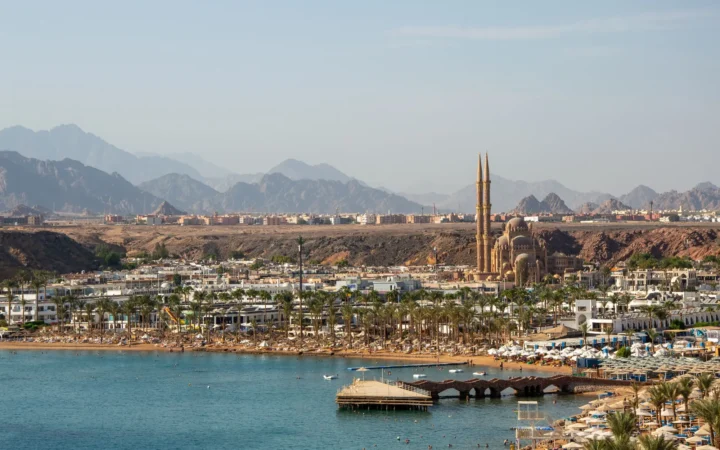
- Tour guiding is closed to foreigners. Tourism companies in Sharm El Sheikh, as everywhere in Egypt, should not plan programmes around a foreign guide.
Hiring foreigners in hotels, restaurants and dive centres
Tourism adds a second approval. The Ministry of Tourism runs its own foreign-staff approval for hotels, tourist restaurants and cafés, tourism companies, and diving and marine centres. It comes in addition to the labour permit, not instead of it, so a hotel in Naama Bay or a dive centre in Hadaba deals with two ministries for the same employee.
Dive professionals add a third layer, set by the Chamber of Diving and Water Sports (CDWS):
- A resident foreign dive professional needs an employer licensed by the Ministry of Tourism, a work permit and a CDWS card.
- While the work permit is pending, a 2-month temporary CDWS card is available.
- Accident insurance has been required for the card since 31 January 2023.
- External instructors who bring their own clients need neither the work permit nor the CDWS card.
The sector detail is in our guide to hiring foreign staff in a Sharm hotel or dive centre.
How to hire a foreign employee under Labour Law 14/2025, step by step
Timelines depend on the authority and any sector approval, so we publish no fixed durations.
- Check your headroom. Identify the staffing rule that binds your company, then count current staff and payroll by nationality.
- Check the role and the person. Make sure the role is open to foreigners (tour guiding is reportedly closed) and check whether the person is exempt, for example on investor residence. An exempt person needs the 7-day notifications instead of a permit.
- Line up the sector approval. Tourism establishments need the Ministry of Tourism approval; dive professionals need a CDWS card, or the temporary card while the permit is pending.
- File the work permit and pay the fee set by ministerial decision.
- Build the residence on the permit. Work is one of the purposes for which Egypt grants residence, and the employee's work-based residence rests on the permit. The routes are compared in our guide to Egypt residency requirements.
- Run the file after the start date. Absence reports, renewals, end-of-work notifications for exempt staff and, when the job ends, repatriation.
What must an employer do once a foreigner is on the payroll?
The permit starts the employer's obligations rather than ending them. Under Labour Law 14/2025 you report a foreign employee absent for 15 consecutive days (Art. 72), notify the start and end of work within 7 days for anyone working under an exemption (Art. 71), and cover repatriation when the job ends unless the contract says otherwise (Art. 74).
Keep the permit and the residence moving together. A residence based on work is only as current as the permit behind it, so a lapsed permit becomes a residence problem for the employee and a compliance problem for you.
Salary tax and insurance for foreign staff are payroll questions in their own right; our payroll and social insurance service covers them.
Planning foreign hires: where the quota and the file meet
Most employers fit one row of this table.
| Your situation | Check first |
|---|---|
| You own and run your company yourself | Whether investor residence covers you instead of a permit, and the 7-day notifications |
| You are close to 10% foreign staff | Which limit binds your company, and whether the 20% route or a ministerial exception is open |
| Your company is a JSC | If the Law 159 ratios apply, the 75% rule for technical and administrative staff |
| You need a specialist for a few days | The 14-day short-term rule, as reported, and its approval |
The hard cases sit between rows: a dive centre near its foreign-staff limit that needs one more instructor before the season, or a Sharm JSC whose foreign general manager's salary weighs on the wage test. The answer turns on numbers that are yours, not ours to publish: headcount, payroll split and the approvals already on file.