Egypt residency requirements come down to one question the passport office asks before any other: what is your purpose here? There is no single "residency visa". Under Law 89/1960, Egypt grants residence by purpose (investment, property ownership, work, family, study or tourism), and you prove that purpose with a file. As of October 2026 there is no dedicated retirement visa, and a newcomer receives renewable residence, not permanent residence.
That sounds simple, and for many people it is. The difficulty is usually upstream: the company that has to exist before investor residence, the property contract that has to be registered before it counts, the work permit that has to be issued before a work-based residence can follow. So most of the work in a residence file happens before you reach the passport counter.
This guide sets out every route, what each one demands, what it costs, how renewals work, and where Sharm El Sheikh and South Sinai differ from the rest of Egypt. When you are ready to file, our residence permit service takes it from there.
What are Egypt residency requirements in 2026?
Every residence permit, whatever the route, rests on the same three pieces:
- Your passport and the status you entered on.
- A purpose the Interior Ministry recognises.
- Proof of that purpose.
The fees are the small part. They are paid from hard currency converted through a bank, with a recent bank receipt; under the 2023 rules the receipt could be no more than 15 days old, so check current practice before you pay. The official fees themselves come to a few hundred Egyptian pounds. What costs time and money is the purpose behind the permit: a company, a registered property, a job with a work permit.
Here is how the six purposes compare.
| Route (purpose) | Typical applicant | The file is built around |
|---|---|---|
| Investment | Shareholder or manager of an Egyptian company | The company's registration and your role in it |
| Property ownership | Owner of a residential property | Registered title and the property's registered USD value |
| Work | Employee of an Egyptian employer | The work permit under Labour Law 14/2025, plus any sector approval |
| Family | Someone joining family in Egypt | Proof of the family relationship |
| Study | Student enrolled in Egypt | Enrolment |
| Tourism | Long-stay visitor with no other purpose | Passport, entry status and the bank receipt |
Two consequences follow from this structure. First, you cannot apply for "residency" in the abstract; you apply for residence for a reason, and the reason has to stay true for the permit to be renewed. Second, the choice of route is not cosmetic. A company owner who also owns a flat may qualify under more than one purpose, and the two files are not renewed on the same basis: one depends on the company, the other on the property.
Is there permanent residency or a retirement visa in Egypt?
No, on both counts, as of October 2026. Egypt has no dedicated retirement visa, and a foreigner arriving now does not receive permanent residence. What you get is renewable residence: a permit for a fixed term under one of the purposes above, renewed for as long as that purpose holds.
Two things are often mistaken for permanent residence. The first is investor residence, which the May 2023 regulation allows to be renewed for the life of the project. It can last as long as your company does, but it is still a renewable permit. The second is Egyptian citizenship by investment, a separate programme with its own thresholds and a USD 10,000 application fee set by Law 28/2023. We cover it further down, because it often comes up in the same conversation.
How to get residency in Egypt through your own company
For business owners this route has a practical advantage: the permit follows the company. As of October 2026, investor residence is renewable for the life of the project under the May 2023 regulation, and holders of investor residence are exempt from the work-permit requirement.
The order matters, because the company comes first. Foreigners can own 100% of most investment projects in Egypt. The exceptions are commercial agency (restricted to Egyptians), importing for trade, and Sinai, where two different regimes apply:
- Sharm El Sheikh, Dahab and the Gulf of Aqaba tourism sector (within the maps of Decree 128/2022, in force since 1 Apr 2022): a non-Egyptian investment project must take the form of an Egyptian joint-stock company (JSC). The decree sets no minimum Egyptian percentage, but changes of founders, shareholdings or articles need approval from the Ministries of Defence and Interior and General Intelligence, plus GAFI or FRA approval.
- The rest of Sinai, such as El Tor, Saint Catherine and Ras Sudr: Law 14/2012 applies, which means a JSC with at least 55% Egyptian ownership and a Sinai Development Agency licence before you start.
So a foreign owner of a dive centre in Dahab and a foreign owner of a consultancy in Cairo begin from different company forms, and their investor-residence files look different from the first page.
Three practical points matter on this route.
The exemption is not silence. Holders of investor residence do not need a work permit, but Labour Law 14/2025 still requires foreigners who are exempt from the permit to be notified within 7 days of starting work, and again within 7 days of ending it.
Security forms and powers of attorney. GAFI's file includes security-inquiry forms for every foreign founder and manager. If you want a foreign colleague to sign at GAFI on your behalf under a power of attorney, that attorney-in-fact needs valid Egyptian residency.
Company capital and residence are different tests. Company law sets no statutory minimum capital for an LLC, and a one-person company needs EGP 1,000, fully paid. Those are company-law rules. They do not tell you what the residence file expects from the company. We do not publish a capital figure for investor residence: the amounts circulating online are not confirmed by an official text we can cite, so we check the current requirement against your company when we prepare the file.
More on this route on our page on investor residency through your company.
Residency by buying property in Egypt
Property ownership is a recognised purpose. The rule that matters is how the authorities measure it: the residence length depends on the registered USD value of the property, and the authorities confirm the current tiers at application.
Note the word "registered". The sources we rely on all speak of registered property, so check the registration status of your contract before you count on this route. A signed contract and a registered title are not the same document.
Before the residence question comes the ownership question, and the answer depends on where the property is.
| Where the property is | What a foreigner can hold (as of October 2026) |
|---|---|
| Most of Egypt | Up to two residential properties of up to 4,000 m² each under Law 230/1996; no resale within 5 years unless an exception is granted |
| Hurghada and the Red Sea tourist area | Foreigners are treated like Egyptians for residential units (PM Decree 548/2005 as amended by 2152/2014), subject to the approval of the competent authorities |
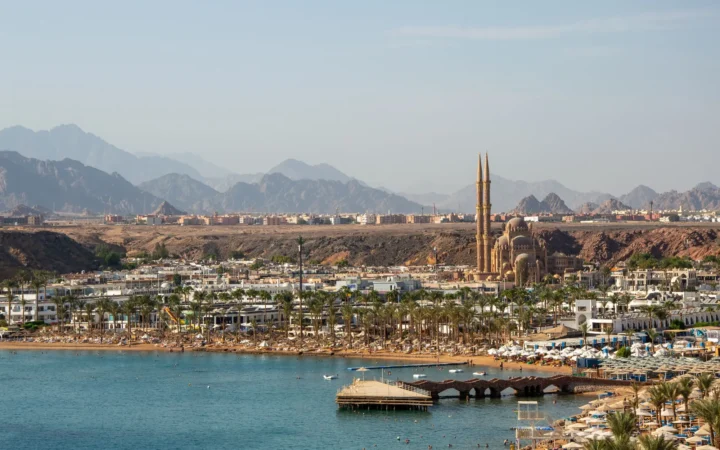
| Sinai, including Sharm El Sheikh | No foreign ownership of land; in Sharm a foreign buyer holds a long-term usufruct, with a term that depends on the contract and the approvals |
Sharm deserves a closer look. Decree 128/2022 reserves ownership of land and buildings in Sharm El Sheikh, Dahab and the Gulf of Aqaba sector for Egyptians and wholly Egyptian-owned entities. It also makes every ownership, allocation, usufruct or real-estate dealing there subject to the prior approval of the Ministries of Defence and Interior and General Intelligence, for Egyptians and foreigners alike; without it the contract is void. Law 11/2024 did not change this: foreign land ownership in Sinai, including Sharm, remains prohibited.
That leaves the obvious question for Sharm buyers: does a usufruct unit count as property for residence purposes? No text we can cite settles it. We treat it as a contract-by-contract check, and we explain the reasoning in our guide to residency through a Sharm apartment purchase.
One more link between property and residence. If you plan to let your flat as a licensed holiday home, the Ministry of Tourism's conditions (announced 6 Apr 2025) require a foreign individual applicant to hold a valid residence permit. Residence is therefore not only about living here; for an owner who rents out, it is part of the licence file.
Getting residency through a job in Egypt
If an Egyptian company employs you, the work permit comes first and the residence follows it. The rules changed recently, so dates matter here.
| Rule | What it says (as of October 2026) |
|---|---|
| Labour Law 14/2025 | Published 3 May 2025, in force 1 Sep 2025; replaced Law 12/2003 |
| Work-permit fee (Art. 71) | Set by ministerial decision |
| Investment Law 72/2017, Art. 8 | Projects may employ foreigners up to 10% of the workforce, or 20% where qualified Egyptians are not available |
| Resolution 279/2025 (reported) | A 10% foreign-staff cap, a 14-day limit on short-term work with approval, and tour guiding closed to foreigners |
Tourism adds a layer. Hotels, tourist restaurants and cafés, tourism companies and diving or marine centres need their own Ministry of Tourism approval for foreign staff, in addition to the labour permit. A resident foreign dive professional also needs an employer licensed by the Ministry of Tourism and a CDWS card; a 2-month temporary card is available while the permit is pending.
The employer carries duties of its own under Labour Law 14/2025. It must report a foreign employee's absence of 15 consecutive days (Art. 72), and repatriation is at the employer's cost unless agreed otherwise (Art. 74). For an employee, the practical point is simple: your residence is only as current as your permit, so a lapsed permit is also a residence problem.
We handle the employer side, from quota planning to the permit file, on our page on work permits for foreign staff.
Family, study and tourist residence
The family route is for people joining family in Egypt, and the file is built around proof of the relationship. Study residence follows enrolment. Neither is complicated in principle; most of the work is in the documents.
Tourist residence is the category left for a long-stay visitor with no other purpose, for example a retiree who rents rather than owns. Its terms are confirmed at application, and we would not plan a move around a duration or fee you read on a forum. If you hold property or a company, it is usually worth checking whether one of those routes fits first.
Retiring in Egypt: which residence do retirees use?
The phrase "retirement visa" appears on many websites, but Egypt has no such visa as of October 2026. A retiree applies under one of the existing purposes:
- Property ownership, if you own a registered residential property (with the Sharm usufruct question above).
- Family, if you are joining family in Egypt.
- Tourism, if you neither own property nor have family here.
The next question is usually the pension. PwC's Egypt summary lists pensions as exempt from Egyptian income tax, but how that applies to a pension paid from abroad is a question we confirm for your case rather than a line we publish. The same goes for treaty relief between Egypt and your home country.
What a retiree should not do is treat residence and tax as one decision. The permit lets you live here; where you pay tax is a separate test, covered below.
How much does residency in Egypt cost?
There are two kinds of cost: the government fees for the permit, which are small, and the cost of the purpose behind it, which is where the money goes.
| Item | Amount, as of October 2026 | Notes |
|---|---|---|
| Residence permit fees | A few hundred EGP | Paid from hard currency converted through a bank; the 2023 rules required a receipt no more than 15 days old. Check current practice before you pay. |
| Work permit (work route) | Fee set by ministerial decision | Labour Law 14/2025 |
| Property route | The property itself | Residence length depends on the registered USD value; tiers confirmed at application |
| Investor route | Setting up and running your company | No capital figure published here; confirmed for your company |
| Citizenship by investment (separate programme) | USD 10,000 application fee | Plus the investment itself (PM Decree 876/2023, Law 28/2023) |
| Our work | Quoted for your file | Depends on the route and how complete your documents are |
Be wary of any article that gives a single all-in residency price. The official fee is the small part, and the rest depends entirely on the route you choose.
How to apply for a residence permit in Egypt, step by step
The sequence is the same for every route. What changes is step 2.
- Choose the purpose before you collect documents. The purpose decides the file, and changing route halfway means rebuilding it.
- Put the purpose in order. For a company: registered, with your role recorded. For property: a registered contract. For work: the work permit and any Ministry of Tourism or CDWS approval. For family: the documents that prove the relationship.
- Check your entry status. Your passport and the stamp you entered on are part of the file. If you entered on a Sinai-only stamp, or your status has lapsed, tell us before you file.
- Pay through a bank. Convert hard currency through a bank and keep the receipt; under the 2023 rules it could be no more than 15 days old when you file.
- Book and file. Appointments are booked on the Interior Ministry portal, eres.moi.gov.eg. In Sharm El Sheikh, Google Maps lists the Police Complex (المجمع الشرطي) as the passport and visa office; check the hours before you go.
- Diary the renewal. Note the expiry date and keep the purpose valid in the meantime.
Timing depends on the route and on how complete the file is, so we give you a realistic range for your case rather than a promise here.
Renewing an Egyptian residence permit
A renewal is a fresh check that your purpose still holds, so the real work happens between renewals, not in the week before. For the property route, the registered ownership must still be yours. For the work route, the permit must be current. For the investor route, the permit is only as solid as the company behind it.
That last point is where an accountant earns their place. A company that carries your residence also carries its own obligations, and we keep them current:
- tax returns filed on time;
- books, which become mandatory for every business from tax period 2028;
- e-receipts, required since 1 Nov 2022 for every business in the Sharm El Sheikh area that sells to consumers;
- the Commercial Register, renewed every 5 years (a late application within 90 days costs double the fee).
None of these is a residence rule in itself. Together they decide whether the company you base your residence on is still in good standing when the renewal comes round.
Overstayed or undocumented? The regularisation window
If your status has lapsed, there is a way back as of October 2026. PM Decree 2807/2026, published in the Official Gazette (issue 37 bis) on 14 Sep 2026, extends by one more year the window for undocumented foreigners to regularise their status.
We do not publish overstay fine amounts, because the figures in circulation conflict. If this applies to you, send us your entry date and current status before you go to the office; the order in which you fix things matters.
Citizenship by investment is a separate programme
Egyptian citizenship by investment is not a residence permit, but it comes up in the same conversations, so here are the routes under PM Decree 876/2023 as of October 2026.
| Route | Amount | Condition |
|---|---|---|
| Property | USD 300,000 | Held for 5 years |
| Bank deposit | USD 500,000 | Held for 3 years, refunded in EGP |
| Company plus donation | USD 350,000 investment and a USD 100,000 donation | Both required |
| Donation | USD 250,000 | Paid as a donation |
Every application carries a USD 10,000 fee set by Law 28/2023. Since 2025 applicants must make in-person visits, and 36 citizenships were granted in 2025. For most business owners and retirees, renewable residence is the practical goal; citizenship is a different decision with a different price.
Residence permit or tax residence: not the same test
A residence permit lets you live here. Tax residence is a separate test. Under Egyptian rules you are tax resident if you have a permanent home in Egypt or spend more than 183 days here in 12 months. Residents are taxed on Egyptian income, and on foreign income only if their centre of activity is in Egypt. Egypt has no inheritance, gift or net-wealth tax.
Egypt has tax treaties with Italy, Russia, the UK, Germany, Ukraine and Poland. Which country taxes a salary, a rent or a pension under a treaty is a question for your own figures. Mixing the two tests up is expensive in both directions: some residents assume the permit makes them Egyptian taxpayers on everything, others assume that without a permit they owe nothing here. Our page on tax for expats and retirees covers the personal side.
Which residence route fits your situation?
Most people fit one row of this table cleanly.
| Your situation | Route to look at first | What to check before you commit |
|---|---|---|
| You own or run an Egyptian company | Investor residence | The company's form (a JSC for non-Egyptian projects in Sharm) and that its filings are current |
| You are buying or already own an apartment | Property ownership | Registered title, the registered USD value and, in Sharm, the usufruct question |
| An Egyptian employer has hired you | Work | The work permit, the foreign-staff limits and any Ministry of Tourism or CDWS approval |
| You are joining family in Egypt | Family | Proof of the relationship |
| You are retired and rent your home | Tourism, or ownership if you buy | The current terms at application |
| Your status has lapsed | Regularisation first | The window under PM Decree 2807/2026 |
The hard cases sit between rows. An owner of a Sharm usufruct flat who also holds shares in a local company. A retiree weighing a purchase in Hurghada against renting in Sharm. A manager whose employer is close to its foreign-staff limit. In those files, choosing the route is most of the work, and the property tiers or capital figure that apply on the day you file decide whether the plan holds.